


How to Choose the Right Pruner Size for Your Hand
When choosing a pruner, many people first look at cutting capacity, or the reputation of the manufacturer. But there is another parameter that directly affects how comfortable the tool is to use — the size of the tool relative to your hand.
A pruner that is too large could be uncomfortable for precise pruning and may require you to change the position of your wrist more than necessary. A tool that is too small, on the other hand, could be uncomfortable when working with denser branches.
At the same time, there is no rule that someone with a large hand has to use the largest pruner. Comfort depends not only on the overall length of the tool, but also on the shape of the handles, the distance between them, blade length, balance, and the type of work.
That is why it is more accurate to choose a pruner not simply based on hand size, but by combining the tool size, the type of work, and how confidently you can control the tool.

What Pruner Sizes Are Available?
Japanese models in the Kenzan Kyiv range clearly show how tool size changes:
180 mm — a compact;
200 mm — a medium and most versatile size;
210 mm — a larger;
227 mm — the largest model.
But the same overall length does not necessarily mean the same feel in the hand.
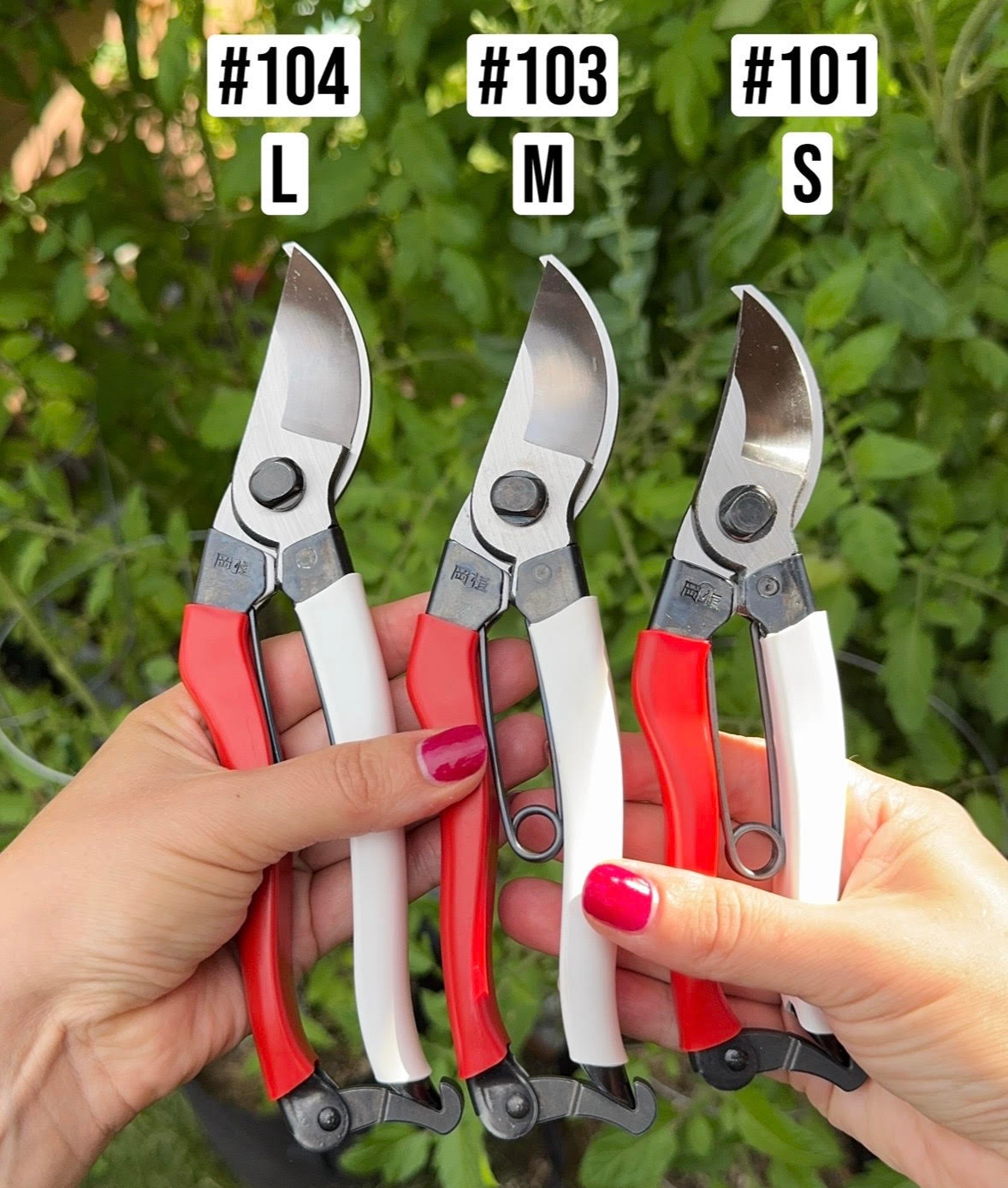
For example, ARS VS-7Z is 180 mm long and size S, while Okatsune #101 is also 180 mm long and belongs to the compact S size. However, these are differently designed tools, so when choosing a pruner, you should not just look at the 180 mm figure.
Why Pruner Length Is Not the Same as Hand Size
A figure such as 180, 200, or 227 mm refers to the overall length of the tool, not the size of your hand.
Two pruners with the same overall length can feel completely different because of the following factors:
handle shape;
distance between the handles;
pivot position;
cutting head length;
weight and balance;
lock and spring design.
Therefore, choosing a tool based only on the principle "longest pruner” is not the best approach.
A much more useful question is:
Can I fully control the pruner and close it easily with my hand in the position I normally use when cutting?

How to Tell if a Pruner Is Too Small
A pruner that is too small usually reveals this during actual work.
You may have to squeeze the handles more firmly to make an ordinary cut. Your hand gets tired more quickly, and when working with denser branches, you may feel that the tool does not provide sufficient leverage.
That does not mean that a small pruner is a bad tool.
For example, ARS VS-7Z, 180 mm long and size S designed for precise work and has a maximum cutting capacity of up to 15 mm. It is a full-size professional tool, not a “smaller version” of a larger pruner.
Okatsune #101 is also 180 mm long, size S, and weighs 177 g. The manufacturer describes this model as the most compact of the three pruners in the range and particularly suitable for smaller hands.
For a smaller hand, this may be exactly what you need.
How to Tell if a Pruner Is Too Large
A pruner that is too large is often uncomfortable not during a single cut, but during a series of repetitive movements.
If you have to:
open your hand too widely;
change your hand position frequently;
control the handles more firmly with your fingers;
apply unnecessary force when closing the tool;
work with a large cutting head when precision is more important,
then the tool may be too large for your particular task.
This is especially noticeable when pruning small shrubs, roses, and young shoots.
Therefore, a larger model does not always mean more comfortable work.
180 mm: When to Choose a Compact Pruner
A size of around 180 mm is a good option when compactness, control, and precision are important.
Your range includes several models of this size.
ARS VS-7Z — 180 mm, Size S
ARS VS-7Z is 180 mm long, size S, and has a maximum cutting capacity of up to 15 mm.
A lightweight and ergonomic professional pruner suitable for daily work.
This size is particularly interesting for those who value good control of the cutting head and work with moderate branch thickness.
Okatsune #101 — 180 mm, Size S
Okatsune #101 is the most compact of the three main Okatsune sizes. Length — 180 mm, weight — 177 g. Its stated maximum cutting capacity is up to 25 mm.
This is a good example of why pruner size and cutting capacity are not the same thing.
Tobisho Type B 180 mm
Tobisho also offers a Type B version with a length of 180 mm. Kenzan Kyiv describes it as slightly smaller than the standard model and as a suitable option for those who want a more compact and lightweight tool. The model is fully forged and designed for work with trees and fruit and garden crops.
If you like the classic Tobisho design but the standard 200 mm tool seems too large, the 180 mm size is worth considering first.
200 mm: The Versatile Size
If you are unsure between a smaller and larger pruner, a size around 200 mm is often the most versatile.
And here it is especially useful to compare three different models:
ARS VS-8Z — 200 mm, M;
Okatsune #103 — 200 mm, M;
Tobisho Type B — 200 mm.
In other words, the user gets a similar overall length, but completely different tool designs.
ARS VS-8Z — 200 mm, Size M
ARS VS-8Z is 200 mm long, size M, and has a maximum cutting capacity of up to 20 mm.
Kenzan Kyiv states that size M is suitable for most hands, while the pruner itself is balanced and designed for extended work.
This is a good option for those who find 180 mm too small but 227 mm too large.
Okatsune #103 — 200 mm, Size M
Okatsune #103 is 200 mm long, weighs 202 g, and is size M.
Kenzan Kyiv states a cutting capacity of up to 25 mm and recommends this model for shrubs, roses, fruit trees, and vines.
Interestingly, #103 has the same overall length as ARS VS-8Z, but that does not mean the two tools feel the same in the hand.
Tobisho Type B 200 mm
The 200 mm Tobisho Type B is the standard version of this design.
Kenzan Kyiv specifies the length of 200 mm and positions this pruner for pruning trees and flowers, as well as gardening, agriculture, and landscaping work. The body is fully forged using traditional methods.
If 180 mm seems too compact for you, the 200 mm version provides a longer tool while retaining the familiar Type B design.

210 mm: When You Need a Slightly Larger Tool
The difference between 200 and 210 mm may seem small.
But in the hand, an additional 10 mm can change the feel of the tool, especially together with greater overall weight.
Okatsune #104 — 210 mm, Size L
Okatsune #104 is 210 mm long, weighs 245 g, and has a cutting capacity of up to 25 mm. Kenzan specifically states that the model is ideal for larger hands, although it can also be used by people with medium-sized hands.
This is a good option for those who need a larger tool but do not want to move immediately to a very long model.
227 mm: The Large Size
The longest model in Kenzan Kyiv range is ARS VS-9Z — 227 mm, size L.
Kenzan Kyiv specifies a length of 227 mm, size L, and a maximum cutting capacity of up to 20 mm. The product page also states that this size is suitable for most hands and designed for extended work.
There is no need to choose 227 mm simply because you have a large hand.
This size is interesting when you genuinely need longer handles, a wider grip range, and a larger tool.
180, 200, 210, or 227 mm: How to Choose
If we simplify the comparison of the models, the picture looks like this.
180 mm
ARS VS-7Z — S, compact professional option.
Okatsune #101 — S, the most compact Okatsune model.
Tobisho Type B 180 mm — a smaller Type B version for those who want compactness.
200 mm
ARS VS-8Z — M, versatile size.
Okatsune #103 — M, versatile 200 mm model.
Tobisho Type B 200 mm — standard Type B size.
210 mm
Okatsune #104 — L, 210 mm, larger tool.
227 mm
ARS VS-9Z — L, the longest option of the listed models.
How to Choose the Right Pruner Size Without Measuring Your Hand
You do not need to measure your hand to the millimeter to choose a pruner.
It is much more practical to evaluate three things.
First — how freely you hold the tool.
The handles should not force you to stretch your fingers excessively.
Second — how easily you can close the pruner.
If every cut requires you to squeeze your hand hard, the tool may be too large or the task may be beyond its optimal working range.
Third — how your hand feels after several dozen cuts.
Extended work is the best way to determine whether a particular size suits you.
One cut can feel comfortable with almost any tool.
Fifty consecutive cuts are a much more informative test.
[How to Choose a Japanese Pruner for the Garden — 7 Important Parameters]

Which Size to Choose for a Small Hand
If you have a small hand, it makes sense to start with models around 180 mm.
In your range, these are:
However, you cannot assume that 180 mm will automatically suit every person with a small hand.
The shape of the particular pruner is just as important as its overall length.
Which Size to Choose for a Medium-Sized Hand
For a medium-sized hand, a range around 200 mm is often a sensible starting point.
Here you have three interesting options:
200 mm is a convenient starting point for those who need a versatile garden pruner without having to move to larger models.
Which Size to Choose for a Large Hand
If you are more comfortable working with a larger tool, consider:
But the type of work should also be taken into account.
If you frequently make precise short cuts in dense shrubs, a very large pruner may be less convenient than a medium-sized model.
One Person — Different Pruners for Different Tasks
Sometimes the attempt to find one universal size leads to compromise.
For example, 180 mm may be more convenient for working with roses and small shoots.
For regular shrub — 200 mm.
For larger branches and extended work — 210 or 227 mm.
That is why a professional gardener may quite reasonably have several pruners of different sizes.
This is not a duplication; it is a way of assigning different tasks to different tools.
Which Size to Choose If You Are Choosing Between Two Models
If you are choosing between 180 and 200 mm, start with the question:
What matters more to me — compactness and control, or greater leverage and versatility?
Between 200 and 210 mm, the question is usually less about hand size and more about your preference for a particular model.
And between 210 and 227 mm, it is especially important to consider weight, balance, and the duration of your work.
If you can try the tool before buying it, the most useful test is several dozen consecutive opening and closing movements while simulating your normal work.
Pruner Size Is More Than Just Length
A properly sized pruner should feel like an extension of your hand.
Therefore, do not look only at the number of millimeters.
Consider:
tool length;
S, M, or L size;
weight;
handle shape;
distance between the handles;
type of work;
the thickness of the branches you normally cut.
For example, Okatsune #101 and ARS VS-7Z are both 180 mm long, but differ in weight and design. Okatsune #103 and ARS VS-8Z are both 200 mm long, but are also different tools in terms of design and construction.
Therefore, millimeters are only a starting point.

Which Size Japanese Pruner Should You Choose?
If you need a compact tool for a small hand and precise work, look at models around 180 mm:
If you need a more versatile size around 200 mm:
If you need a larger tool:
In the end, the right size is not the one that matches your hand based on a chart.
The right size is the one that allows you to make the required cut without unnecessary strain, confidently control the blade, and work through a series of cuts without overloading your hand.


Comments