


Bypass Pruners vs. Anvil Pruners: What’s the Difference and Which Should You Choose?
When choosing garden pruning shears, a common question is: which is better — a bypass pruner or an anvil pruner?
At first glance, both tools do the same job — cutting branches. But they work on different principles, so the tasks they are best suited for also differ.
The right choice is especially important if you prune roses, fruit trees, ornamental shrubs, or prune a large number of plants.
Let’s look at how a bypass pruner differs from an anvil pruner, what kind of cut each one produces, and which type of tool to choose for a particular job.

What Is a Bypass Pruner?
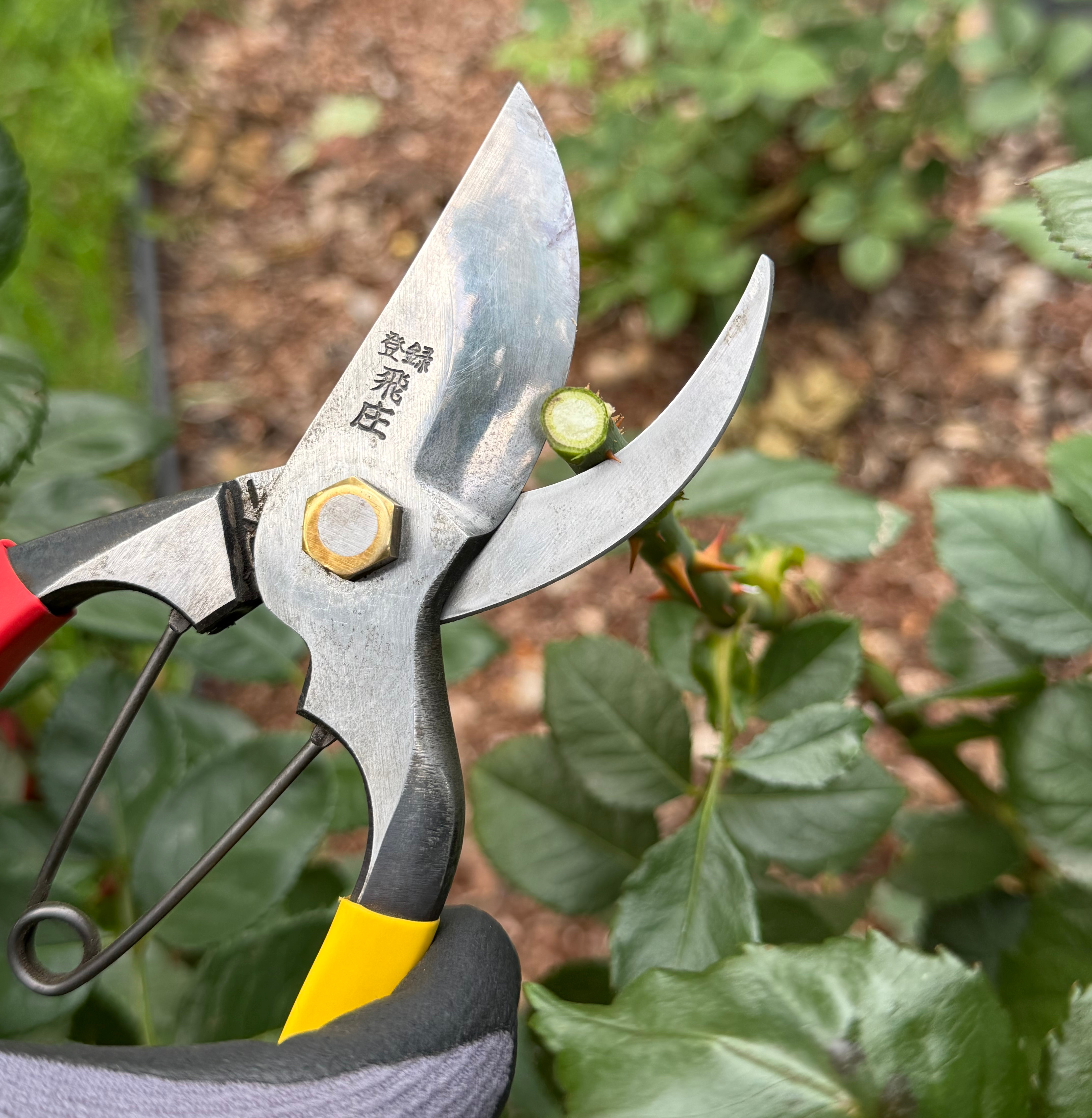
A bypass pruner works on the same principle as scissors.
One blade is the cutting blade, while the other serves as the support blade. As the handles close, the cutting blade passes close to the counter blade and cuts through the branch.
The main advantage of this design is its ability to make a clean and relatively precise cut in living wood.
That is why bypass pruners are particularly well suited for:
roses;
fruit trees;
ornamental shrubs;
young shoots;
flowers and plants with soft or moderately dense wood.
With proper sharpening, a good bypass pruner should not crush the shoot. The cutting blade cuts through the plant tissue instead of merely squeezing it.
Most Japanese pruner model in the Kenzan Kyiv range belong to this type of tool.
For example, the ARS VS-Z series is available in three sizes: VS-7Z — 180 mm, VS-8Z — 200 mm, and VS-9Z — 227 mm. On the Kenzan Kyiv pages, these models are described as tools for precise and easy cuts; VS-7Z is specified for cutting up to 15 mm, VS-8Z — up to 20 mm, and VS-9Z — up to 20 mm.

What Is an Anvil Pruner?
An anvil pruner Chikamasa PSV-8 works differently.
Its cutting blade does not pass alongside a counter blade. Instead, it presses the branch against a wide support surface — the anvil.
This design makes it effective for working with harder wood and, in some applications, makes it easier to cut dry branches.
But there is an important difference when working with thin live wood.
The support surface does not cut the branch; it takes the pressure. Therefore, if used incorrectly, a soft or thin shoot may be deformed more severely.
That is why, when choosing between the two types of pruners, it is important to consider not only branch thickness but also the condition of the wood.

The Main Difference Between the Two Designs
The difference can be explained very simply.
Bypass pruner:
The cutting blade passes close to the counter blade;
the branch is cut through;
the cut is more precise;
the design is particularly suitable for live shoots.
Anvil pruner:
The cutting blade presses the branch against the support surface;
the design is well suited to hard and dry wood;
when working with soft live shoots, the risk of deformation should be taken into consideration.
Therefore, the question “which pruner is better?” is not quite the right one.
A better question is:
“Which pruner is suitable for your type of wood and your tasks?”
[How to Choose a Japanese Pruner for the Garden — 7 Important Parameters]

Which Pruner Should You Choose for Roses?
For roses, a bypass pruner is considered first.
When pruning roses, a clean cut without excessive crushing of the tissue is especially important. That is why a design with two opposing cutting blades are the most logical choice here.
Among the listed models, Toyama Hamono YP165G Gold can be considered for these tasks; Kenzan Kyiv offers it for cutting branches, roses, flowers, and houseplants. It is 165 mm long, weighs about 130 g, and has a stated maximum cutting diameter of approximately 10 mm for untreated wood.
Another option for compact and precise work is the Sakagen P-180. On the Kenzan Kyiv website, the manufacturer emphasizes a clean and precise cut, minimal damage to the stem, and the ability to cut branches up to 1.5 cm in diameter.
Bypass Pruners for Fruit Trees
Bypass pruners are also widely used for pruning apples, pear, plum, and other fruit trees.
This is especially relevant when working with live branches, where the goal is to make a neat cut without unnecessary damage to the plant tissue.
The following factors are especially important here:
blade sharpness;
cutting head geometry;
the correct pruner size;
matching the tool to the branch diameter.
For example, Okatsune #103 is about 200 mm long and can cut up to 25 mm, while Okatsune #104 is 210 mm long and also cuts up to 25 mm. These models are designed for more demanding branch work than compact pruners.
For a smaller hands, the same range includes the Okatsune #101, size S and 180 mm long.

When Do You Need an Anvil Pruner?
An anvil pruner is worth considering primarily when your main work involves hard, dry, or heavily lignified wood.
Its design is intended not for the most delicate cut, but for transferring force through the cutting blade and support surface.
Instead, let’s consider the Chikamasa PSV-8 pruner, which is an excellent choice for gardeners. This tool is highly durable and long-lasting thanks to the use of quality materials. The pruner blades are made of carbon steel, which provides sharpness and makes sharpening easy. In addition, the ergonomic handles ensures comfortable use, making the Chikamasa PSV-8 an ideal helper for pruning plants and garden maintenance.
This is important: the type of pruner should be determined by the design of the specific model, not by its intended use or appearance.

How to Identify the Type of Pruner Before Buying
If you are looking at a pruner and do not know which type it is, look at the cutting head.
On a bypass pruner, you can clearly see two blades working toward each other.
On an Anvil pruner, the second blade is replaced by a support surface.
This simple visual distinction makes it possible to tell the two designs apart even when the manufacturer does not use the words Bypass or Anvil in the product name.
How a Bypass Pruner Feels During a Cut
With a good bypass pruner, the cut feels like the blade progressively biting into the wood.
With the right tool size and a properly sharpened cutting edge, excessive force should not be necessary.
For example, ARS VS-7Z is 180 mm long and a size S, VS-8Z is 200 mm and a size M, while VS-9Z is 227 mm and a size L.
Kenzan Kyiv also specifies precise blade geometry and a smooth, clean cut for these models.
This is a good example of why the same type of pruner can be produced in several sizes.
[How to Choose the Right Pruner Size for Your Hand]

What If the Wood Is Too Thick?
Here is another common misconception.
If a branch is too thick, you do not always need to look for a pruner with an even larger maximum cutting diameter.
At a certain point, the right tool becomes a loppers, and then a pruning saw.
For large-diameter live wood, you can use a pruner of the appropriate class up to its working limit, but you should not consistently overload it.
This approach reduces stress on the mechanism and helps maintain cutting precision for longer.
[When to Use a Pruner, Loppers, or a Pruning Saw]
Which Bypass Pruner to Choose From Japanese Models
The Kenzan Kyiv range includes several options that differ clearly in size and design.
Compact Pruners
Toyama Hamono YP165G Gold — 165 mm, about 130 g, for general maintenance, roses, flowers, and small branches.
Sakagen P-180 — a compact tool about 170 mm long, designed for branches up to 10 mm and intended for a clean, precise cut.
Size S
ARS VS-7Z — 180 mm, S, up to 15 mm.
Okatsune #101 — a compact size S model.
Medium Size
ARS VS-8Z — 200 mm, M, up to 20 mm.
Onoyoshi Type AK 200 mm — a forged pruner made of S58C high-carbon steel, with hand sharpening and blade tension adjustment. Kenzan Kyiv
specifies it for intensive gardening and landscaping work.
Takagi KIKUDO 200 mm — a forged pruner made of KA-70 carbon steel, with a soft spring and a maximum cutting diameter of up to 15 mm.
Chikamasa PSA-G8 210 mm — a bypass pruner with a wide blade, designed for branches up to 25 mm; it features die-cast aluminum handles and a PTFE-coated blade.
Large Models
ARS VS-9Z — 227 mm, size L, up to 20 mm.
Okatsune #104 — 210 mm, size L, with a cutting capacity of up to 25 mm.
So, Which Should You Choose: Bypass or Anvil?
The choice depends primarily on the material you are going to cut.
For live shoots, roses, fruit trees, shrubs, and precision pruning, it usually makes sense to look at the bypass design.
For dry, hard, and heavily lignified wood, an Anvil design can be useful.
But this does not mean that Anvil pruners are automatically better for all thick branches, or that bypass pruners are suitable only for thin ones.
The result depends on several factors: the geometry of the specific model, blade sharpness, branch diameter, wood hardness, and the correct positioning of the pruner.
What Matters More Than the Pruner Type
Even the right design does not guarantee a good result if the tool is chosen incorrectly.
In practice, five parameters matter:
pruner type;
branch diameter and wood condition;
tool size;
cutting-edge sharpness;
how comfortable the tool is in your particular hand.
For example, a heavy professional pruner may be excessive for a few rose bushes at home. A small compact tool, on the other hand, may be uncomfortable if you constantly use it to cut thick, lignified branches.
[How to Choose a Japanese Pruner for the Garden — 7 Important Parameters]

Which Pruner to Choose for a Japanese Garden
If the main task is careful work with live plants, start with bypass models.
For small shoots, you can look at compact Sakagen P-180, Toyama Hamono YP165G, or Okatsune #101.
For more universal garden work, suitable medium-size models include ARS VS-8Z, Okatsune #103, Onoyoshi Type AK, Takagi KIKUDO, or Chikamasa PSA-G8.
For a larger hand and more substantial shoots, you can consider ARS VS-9Z and Okatsune #104.
The Main Difference Is the Character of the Cut
Bypass and anvil pruners solve a similar problem, but they do it in different ways.
A bypass pruner cuts the branch between two working elements and is suitable for careful work with live wood.
An anvil pruner presses the branch against a support surface and can be useful for hard or dry wood.
Therefore, when choosing, you should not assume that one type is universally better than the other.
First determine what exactly you are going to cut, how thick the branches in your garden are, and how important the cleanest possible cut is.
For most tasks involving live plants and precise formative pruning, a bypass pruner is a good starting point.
If your main work involves dry and hard branches, it is worth considering an anvil pruner separately and comparing it with loppers.
[Which Pruner to Choose for Roses]
[How to Sharpen a Japanese Pruner Properly]
[How to Care for a Japanese Pruner So It Lasts for Decades]


Comments