


Loppers or Pruning Shears: Which Is Better for Cutting Branches of Different Thicknesses
When pruning a garden, a seemingly simple question often comes up: which tool should you choose for a branch of a particular thickness, pruning shears or loppers?
In practice, the choice depends not only on branch diameter. You should also consider the condition of the branch, its position, the type of wood, access to the cutting point, and the amount of force required to use the tool.
Choosing the wrong tool can make the work noticeably harder. Trying to cut a thick branch with ordinary pruning shears requires too much force. On the other hand, using long-handled loppers for thin shoots can reduce precision.
Therefore, a good basic principle is simple: thin and medium-sized branches are easier to cut with pruning shears, while thicker branches are better suited to loppers.

How Are Pruning Shears Different from Loppers?
Pruning shears are designed to be used with one hand. Their main advantages are compact size, precision, and the ability to make many consecutive cuts quickly.
Loppers have long handles. Thanks to the greater leverage, they allow you to generate significantly more cutting force without having to squeeze the handles as hard.
This is why loppers become especially useful when pruning shears already require noticeable effort.
When choosing a tool, it is better not to follow the principle “the more powerful, the better”, but rather “enough power for the particular cut.”
How to Choose a Tool Based on Branch Thickness
There is no universal diameter after which pruning shears must be replaced by loppers. The maximum diameter depends on the design of the particular tool, the type of wood, and the condition of the branch.
For practical work, you can use the following guide.
Branch | Preferred Tool | Why |
Thin green shoots | Pruning shears | Precision and fast one-handed work |
Medium-sized branches | Pruning shears | Convenient for making precise consecutive cuts |
Thicker branches | Loppers | Long handles increase leverage |
Hard or dry wood | Loppers or powerful Anvil pruning shears | More force is required |
Thick branch that is difficult to reach | Loppers | Long handles provide additional reach |
Very thick branch | Garden saw | Pruning shears and loppers are no longer the optimal solution |
This is not a strict table of maximum cutting diameters. Each manufacturer specifies the working capabilities of its individual models.
When Pruning Shears Are Enough
Pruning shears are best suited to regular pruning of small branches and shoots.
Their main advantage is most noticeable when precision matters: shaping shrubs, pruning roses and fruit trees, working with ornamental plants, and removing individual shoots.
Pruning shears are easy to hold in one hand, while the other hand can support the branch or move leaves aside, making the work fast and controlled.
Another advantage of pruning shears is their compact size. They are easy to use inside shrubs and in places where the long handles of loppers simply will not fit.

When Pruning Shears Are No Longer the Best Choice
The problem begins when excessive force is required to make a cut.
If the handles are difficult to close, the tool starts bending the branch instead of making a clean cut, or you have to use both hands, this is a good signal to switch to loppers.
Do not assume that the ability of pruning shears to physically cut a branch means that this is the right way to cut it.
Even if the blades close, excessive load increases the strain on your hand and the tool itself.
For regular work, it is better to use a tool with sufficient power in reserve.
When You Need Loppers
The main advantage of loppers is leverage.
Long handles allow you to apply more force to a branch with less strain on the wrist. This makes loppers especially useful when working with thicker branches, hard wood, and branches located deeper inside the canopy.
Long handles also help you reach branches without having to lean too far or reach deep into a shrub.
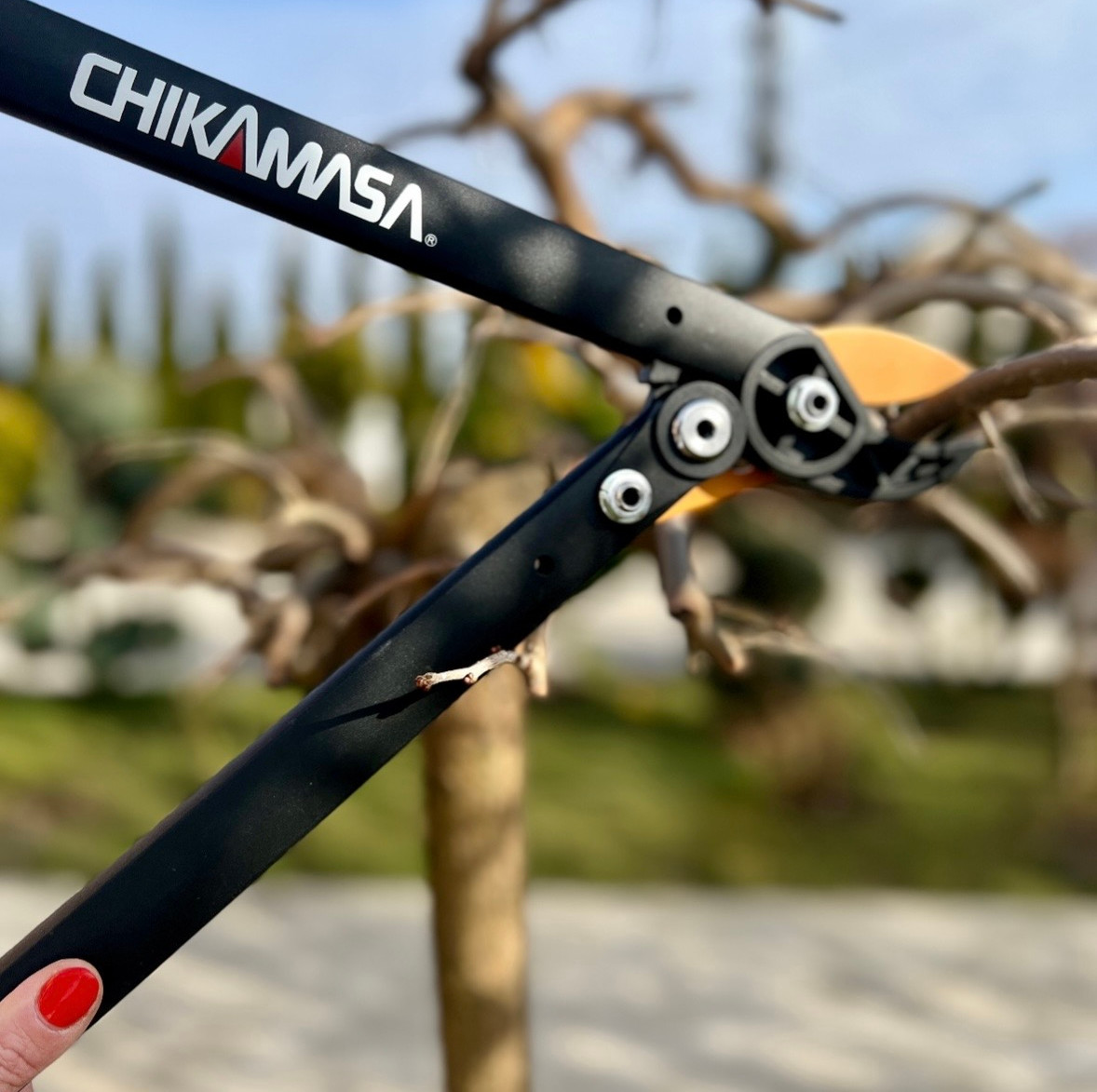
For example, Chikamasa LP-650 has an overall length of 610 mm and a blade length of 53 mm. The tool weighs about 600 g. Its design is intended to increase cutting force, while the ribbed construction improves rigidity. The blades have a fluoroplastic coating that reduces plant sap buildup and makes cutting easier.
This is a completely different class of tool compared with ordinary hand pruning shears.

How the Leverage of Loppers Works
Imagine two situations.
In the first case, you are trying to cut a branch with the short handles of pruning shears. To increase the force, you have to squeeze the tool harder with your hand.
In the second case, the same operation is performed with the long handles of loppers. Because of the handle length, the mechanical advantage is greater, so the required force is distributed more effectively.
This is why loppers can handle branches that are already too demanding for ordinary pruning shears.
At the same time, long handles do not mean that loppers should be used to cut every branch. For branches that are too thick, a garden saw is the more appropriate choice.
What to Do with Hard and Dry Branches
Diameter is not the only factor that matters here.
A young living branch and a dry old branch of the same diameter can cut very differently.
Dry wood usually requires more power, so in some cases loppers are more convenient.
Another option is an Anvil pruning shear. In this design, the cutting blade works against a support surface rather than passing alongside a second cutting blade.
The Kenzan Kyev assortment includes the Chikamasa PSV-8 210 mm. It is an Anvil-type pruning shear with an overall length of 210 mm, a 50 mm blade, and a weight of about 260 g. The blades are made of high-quality carbon steel. The upper blade has electrolytic nickel plating, while the lower blade has an additional fluoroplastic coating. The manufacturer has also made it possible to replace the blade.

Anvil Pruning Shears or Bypass Pruning Shears?
The difference between these designs is especially important when choosing a tool for different types of wood.
In bypass pruning shears, the two cutting elements work like scissors. One blade passes close to the counter blade, which makes this type well suited to clean cuts on live shoots.
In Anvil pruning shears, the cutting blade presses the branch against a support surface. This design can be useful when working with harder and drier wood.
This does not mean that Anvil shears are automatically better than bypass pruning shears.
For thin live shoots, flowers, and most ordinary garden cuts, bypass shears are often more convenient. For harder or dry wood, an Anvil design can provide an additional advantage.

Loppers or Powerful Pruning Shears: What to Choose for Thick Branches?
Sometimes a buyer sees a powerful pair of pruning shears and assumes that loppers are no longer necessary.
In practice, this is not quite true.
Even powerful pruning shears remain a compact tool. Their advantage is maneuverability and precision.
Loppers have the advantage of longer handles and greater mechanical leverage.
Therefore, the two tools can complement each other:
pruning shears are used for most small and medium cuts;
loppers come into play when more force is required;
a garden saw is used for genuinely thick branches.
This combination is more convenient than relying on one universal tool.

How to Tell When a Branch Is Too Thick for Pruning Shears
There are several practical signs.
The first sign: you cannot easily close the handles with one hand.
The second: instead of cutting, the tool starts heavily compressing or bending the branch.
The third: you need to apply unusually high force for one cut.
The fourth: your hand becomes noticeably tired after several cuts.
The fifth: you instinctively start using both hands to close the pruning shears.
In such situations, it is better not to continue forcing the tool and instead switch to loppers.

Why You Should Not Use Loppers for Every Branch
It may seem that because loppers are more powerful, they should always be used.
But this approach has disadvantages.
Long handles are more difficult to maneuver inside a dense canopy. In tight spaces, they can catch on neighboring branches.
In addition, loppers are often simply excessive for thin shoots. Pruning shears are faster, more precise, and more convenient for making many small cuts.
Therefore, when pruning a garden, it is useful to switch between tools depending on the particular branch.

Chikamasa LP-650 Loppers: When Are They Especially Useful?
Chikamasa LP-650 is designed for working with thicker branches, where increased cutting force becomes an advantage.
The model has an overall length of 610 mm, a blade length of 53 mm, and a weight of about 600 g. The manufacturer uses high-quality carbon steel and a fluoroplastic coating. The ribbed construction increases rigidity, while the double power construction makes cutting easier.
This type of lopper is especially logical for a garden owner who regularly works with thicker branches of shrubs and trees.
At the same time, the long handles provide additional access to branches inside the canopy.

Chikamasa PSV-G8: When Are Pruning Shears More Convenient?
Chikamasa PSV-G8 210 mm represents a different approach.
This is a compact 210 mm tool that is convenient when you need the maneuverability of pruning shears but also require more power for working with hard wood.
The Anvil design helps transfer force through the cutting blade and support surface. The model weighs about 260 g. The blades are made of high-quality carbon steel and have protective coatings.
For a gardener, this can be a convenient intermediate option between ordinary bypass pruning shears and long-handled loppers.

What to Choose for Roses, Shrubs, and Fruit Trees
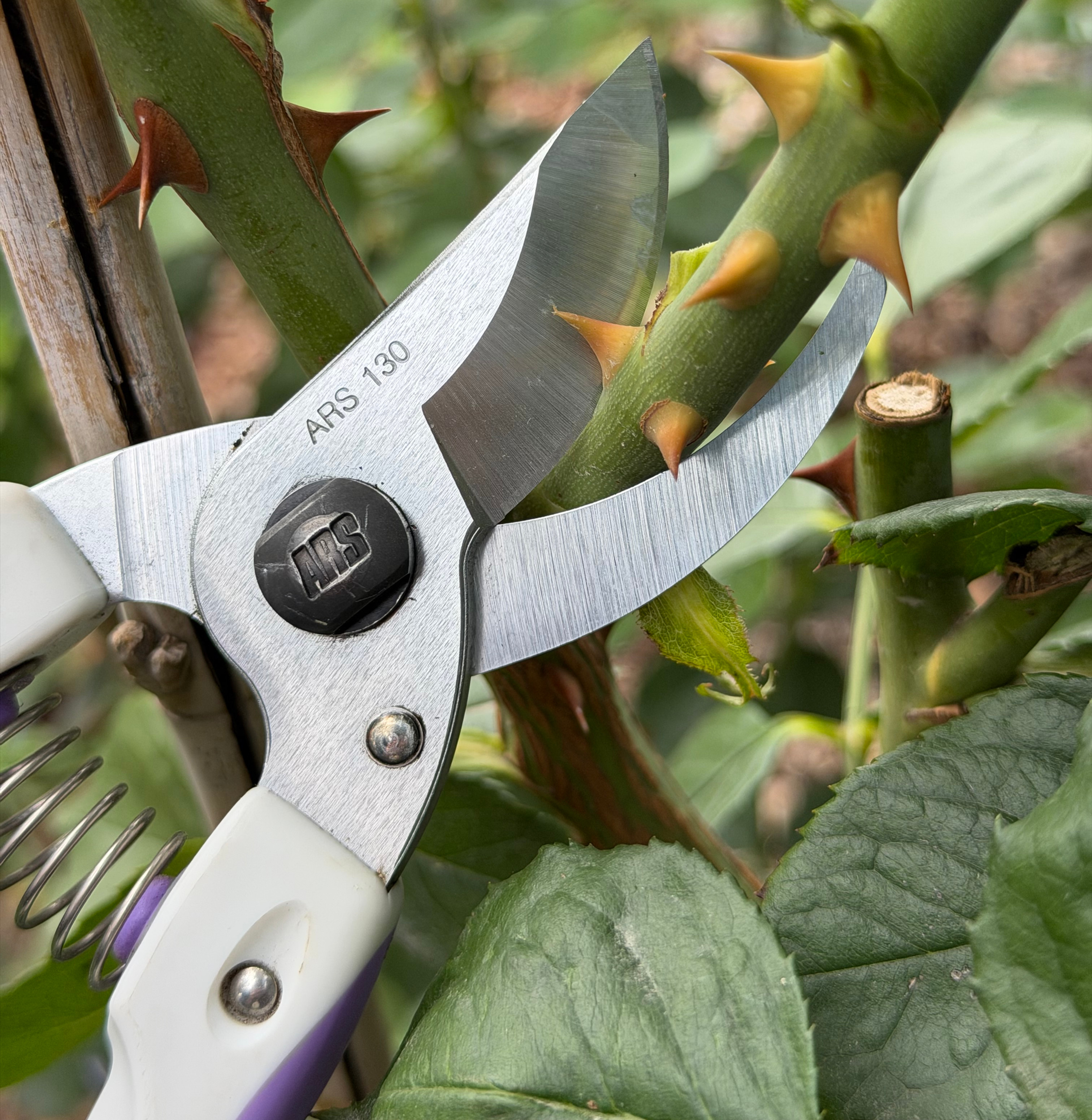
For roses and young live shoots, a good bypass pruning shear is usually the right choice.
For thicker shrub branches, it is more convenient to switch to loppers.
For dry and hard branches, an Anvil pruning shear such as the Chikamasa PSV-8 can be useful.
For genuinely large branches, a garden saw is the better option.
In other words, the right choice is not a competition between tools, but a division of tasks between them.
Do Not Rely Only on the Stated Cutting Diameter
A manufacturer may specify the maximum branch diameter that a particular tool is capable of cutting. But this value should not be treated as a universal recommendation for every type of wood.
The same thickness can feel completely different depending on:
the tree species;
the moisture content of the wood;
whether the branch is live or dry;
whether the branch is positioned straight or awkwardly;
the sharpness of the blade;
the user's strength and technique.
Therefore, the working diameter is better treated as a guideline rather than permission to use the tool at its limit every time.
Which Tool Should You Choose? A Simple Algorithm
If you see a thin live shoot, use pruning shears.
If the branch already requires noticeable effort, switch to more powerful pruning shears or loppers.
If the branch is dry and hard, consider an Anvil design.
If the diameter becomes genuinely large, use a garden saw.
And if the branch is far away or deep inside the canopy, the length of the lopper handles becomes an additional advantage.
Which Tools Should Every Garden Have?
For complete garden pruning, one tool is usually not enough.
An optimal set can consist of three levels.
Pruning shears for thin and medium-sized branches, shoots, and precise cuts.
Loppers for thicker branches when greater leverage is needed.
A garden saw for large branches that are beyond the capabilities of pruning shears and loppers.
Examples include Chikamasa PSV-8 210 mm and Chikamasa LP-650.
The Kenzan Kyev catalog also includes other Japanese loppers, so the tool can be selected according to the specific branch thickness and type of work.

Choosing between pruning shears and loppers is better done not only by maximum cutting diameter.
Pruning shears provide precision, maneuverability, and speed when working with small and medium-sized branches.
Loppers provide additional force and reach thanks to their long handles.
Anvil pruning shears can be useful for harder and drier wood.
A garden saw is needed when a branch becomes too large for pruning shears and loppers.
The main rule is simple: do not force a tool to work at its limit. A good garden tool should make the work easier, not require maximum effort from the user.


Comments