


How to Choose a Garden Saw for Pruning Trees — Japanese Saws
When pruning shears can no longer handle the thickness of a branch, you need a saw for pruning trees. However, choosing the right tool is not as simple as it may seem. Garden saws differ in blade length and shape, tooth size, handle design, and intended use.
For some tasks, a compact folding model that can be carried around the garden is more convenient. For others, you need a long saw with a larger blade that can work quickly through thick branches.
In this article, we will look at what to consider when choosing a saw and compare the Japanese saws available from Kenzan Kiev: ARS PM-24, ARS PM-21, Chikamasa SZ-21FL, ARS 210DX, ARS UV-32E, ARS SA-IK10R, and ARS Silky Gomboy 210-10.

When Do You Need a Garden Saw for Trees?
A garden saw is needed when a branch is too thick for pruning shears or loppers. This may include old branches on fruit trees, thick shoots of ornamental plants, dead wood, and branches located deep inside the crown.
The main advantage of a saw over pruning shears is the ability to work with much thicker wood. At the same time, you should not try to replace pruning shears with a saw for every task: pruning shears are usually faster and more convenient for thin live shoots, while a saw is primarily intended for branches that already need to be sawn through.
Before buying, it is therefore worth considering not only the size of the saw itself, but also the type of work you perform most often.
What Type of Saw Is Needed for Pruning Branches?
When choosing a saw for pruning branches, five main parameters are important: blade length, tooth shape, saw construction, handle comfort, and branch size.
Blade Length
A longer blade allows you to work faster through a thick branch because each stroke covers a greater distance.
A compact blade, on the other hand, is more convenient in a dense tree crown where there is little space between branches.
A larger saw is therefore not necessarily more convenient than a smaller one. If you constantly have to maneuver between branches, compactness becomes a major advantage.
Tooth Size and Pitch
Larger teeth usually remove wood faster when working with thick branches.
A finer tooth pattern is convenient when control and precision are important, especially when working with smaller branches or in confined spaces.
Japanese saws are characterized by teeth designed to cut on the pull stroke. This means you do not need to apply excessive force. It is better to let the teeth do the cutting while maintaining the correct direction of movement.

Straight or Curved Saw
A straight blade is convenient for precise control and for working in different positions.
A curved blade helps keep the saw engaged with the branch and can be especially useful when cutting thicker branches.
That is why both designs are used in professional garden saws.
Folding Design
A folding garden saw is especially convenient for regular garden maintenance. When folded, it is safer to carry and takes up less space.
This format works well for gardeners who constantly move between trees and shrubs.

ARS PM-24 — Long Blade for Thick Branches
ARS PM-24 is a professional folding garden saw with a 240 mm blade.
It is designed for situations where a long working blade and high cutting productivity are needed. The saw features TURBOCUT teeth and is intended for working with thick branches.
The PM-24 has an overall length of 500 mm, while the stated maximum cutting diameter reaches 80 mm. At the same time, the saw remains relatively light for a tool of this class.
This model is particularly interesting when the main task is pruning thicker branches and the additional blade length is genuinely useful.

ARS PM-21 — A More Compact Alternative
ARS PM-21 is a folding saw with a 210 mm blade and an overall length of 440 mm.
Its construction is similar to the PM-24, but it is slightly more compact. The stated maximum cutting diameter is up to 70 mm.
The PM-21 is worth considering when you need a good balance between working length and compactness. This garden saw for trees is suitable for regular pruning when you want a versatile tool without excessive size.
If you often work in a dense crown and still need substantial cutting capacity, the PM-21 is one of the models worth comparing with the PM-24.

Chikamasa SZ-21FL — Lightweight Japanese Garden Saw
Chikamasa SZ-21FL is a Japanese saw with a 210 mm blade and an overall length of 390 mm.
It weighs about 140 g, making it a very lightweight option for extended work.
The blade features impulse hardening, while the Teflon coating helps reduce plant sap buildup and improves resistance to corrosion.
The teeth have a 2.4 mm pitch and are designed for controlled work, while the ergonomic handle provides a secure grip.
Chikamasa SZ-21FL is worth considering when you need a lightweight Japanese garden saw for pruning branches that is comfortable to hold and use for extended periods.

ARS 210DX — Compact Folding Saw for Everyday Use
ARS 210DX is a folding model with a 165 mm blade.
The saw is designed for cutting wood and branches up to 60 mm. Its construction uses a tapered blade, reinforced tooth sharpening, and a pull-cutting motion.
When folded, the tool is about 200 mm long, making it convenient to carry around the garden and store with other gardening tools.
ARS 210DX is a good example of how a compact folding saw can still handle fairly thick branches.
For gardeners who value compactness, mobility, and versatility, this is a practical format.

ARS UV-32E — For Thick and Dense Branches
ARS UV-32E is a professional Japanese saw with a 320 mm curved blade.
This is a different class of tool in terms of working length. The model is designed for thick and dense branches, and its stated maximum cutting diameter is up to 125 mm.
The teeth feature impulse hardening, while the cutting section is coated with Teflon. The curved blade makes the saw particularly suitable for working with large branches.
The UV-32E weighs about 420 g and comes with a sheath.
If you really need a saw for pruning thick branches, rather than simply a compact tool for occasional pruning, the UV-32E is one of the larger-capacity models in this range.

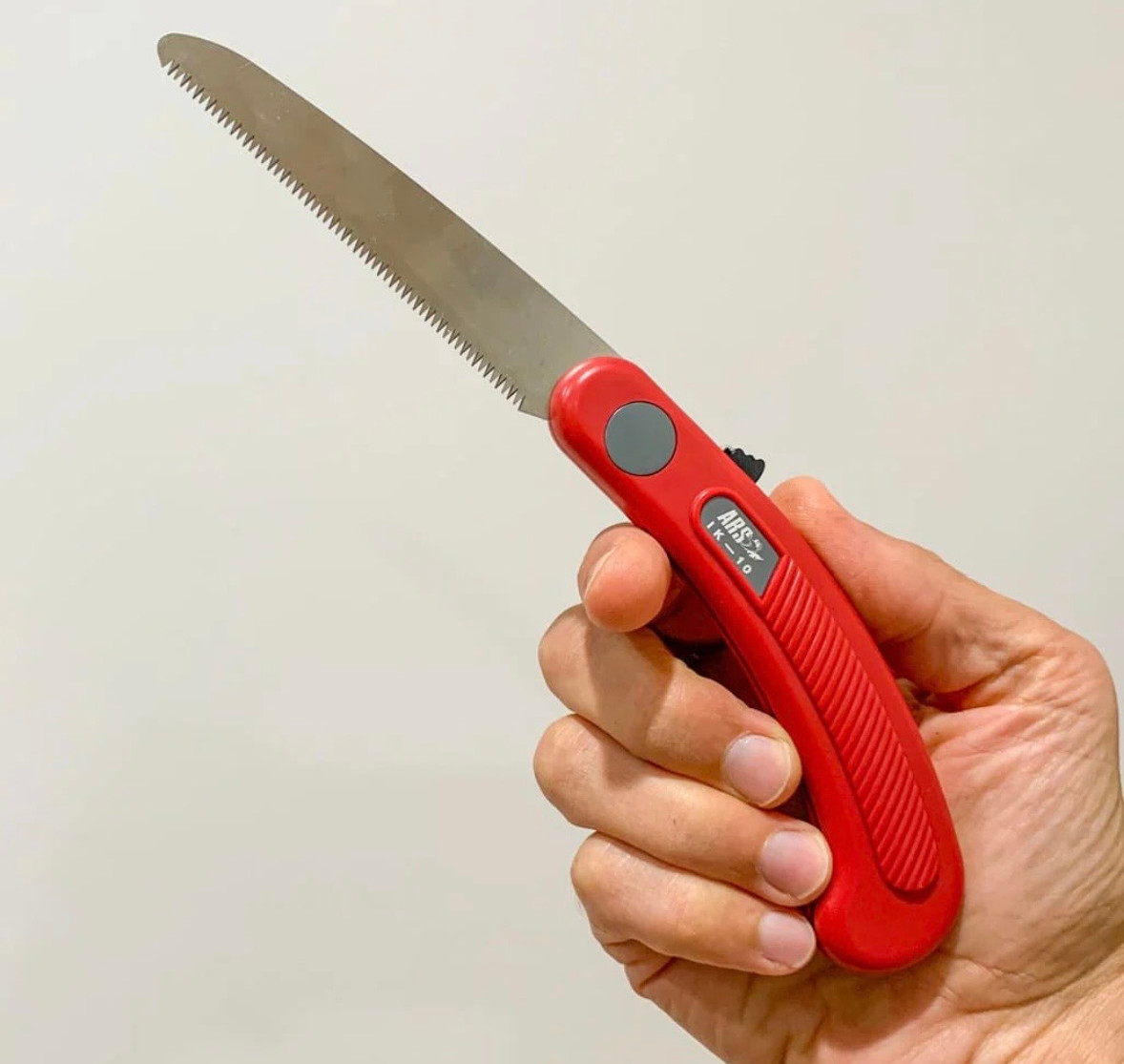
ARS SA-IK10R — For Precise Work in Tight Spaces
ARS SA-IK10R is a small folding saw originally developed for bonsai and ikebana.
Its main advantage is compactness. The blade is about 110 mm long, while the saw is approximately 220 mm long when unfolded.
The model is designed for working in confined spaces and can be used not only for bonsai, but also for smaller garden tasks, pruning shrubs, roses, hydrangeas, and thin wood.
This is not a replacement for a large saw for thick branches, but a completely different type of tool. SA-IK10R makes sense when maneuverability and the ability to reach a branch in a tight space are the main priorities.
Silky Gomboy 210-10 — Versatile Folding Saw
Silky Gomboy 210-10 is a folding saw from the popular Silky Gomboy series.
The model is a versatile folding saw suitable for outdoor work, gardening, and tree maintenance.
It has a thin, rigid blade, and its construction is designed for pull-stroke cutting. The manufacturer specifically emphasizes that this type of sawing does not require forcing the blade forward — the saw should cut through the wood using its own teeth.
The rubber handle sits comfortably in the hand, while the folding design makes transportation and storage easier.
Silky Gomboy 210-10 can be considered a versatile option for gardeners who want a compact folding saw that is convenient to keep at hand.
Which Saw Should You Choose: Short or Long?
The models presented above can be roughly divided according to their intended use.
If you need a compact saw for smaller branches and work in tight spaces, consider ARS SA-IK10R.
If you need a lightweight tool for regular pruning, Chikamasa SZ-21FL and ARS 210DX are worth considering.
If you need a folding tool with a longer blade, look at ARS PM-21 and ARS PM-24.
If the main task is thick and dense tree branches, pay attention to ARS UV-32E.
If you need a versatile folding saw that is convenient to carry with you, Silky Gomboy 210-10 is an option to consider.
When choosing, remember that blade length and maximum cutting diameter are not the only characteristics that matter. The larger the branch, the more important proper access to it, a comfortable grip, and the ability to make the cutting motion freely become.

How to Use a Garden Saw Properly
Even a good saw can perform poorly if it is used incorrectly.
The main rule of Japanese saws is not to try to cut through wood by force.
Hold the saw securely, place the teeth on the branch, and use smooth pull strokes. Do not force the blade during the forward movement.
When pruning a thick branch, it is useful to decide in advance where the main cut will be made. This helps you control the branch and reduce the risk of unwanted splitting.
This is especially important when pruning large tree branches.
Saw or Loppers — Which Should You Choose?
Loppers are convenient when a branch can be cut in one movement. A saw becomes necessary when the diameter of the wood is already too large or when the branch needs to be sawn through gradually.
For some tasks, these tools work very well together.
For example, you can use loppers to remove thinner side branches and a saw for thicker main branches.
More information about choosing loppers for thick branches can be found in [How to Choose Loppers for Thick Branches].
And if you want to understand which cutting tool is suitable for different gardening tasks, a useful starting point is How to Choose Japanese Pruning Shears for the Garden — 7 Important Parameters.
How to Care for a Garden Saw
After use, it is advisable to clean the saw from wood sap and other contaminants. This is especially important for tools that are regularly used on live wood.
Do not leave the saw wet and store it in a dry place. For folding models, it is also important to monitor the condition of the blade locking mechanism.
When the cutting part becomes dirty, you can use [Japanese garden tool cleaning and maintenance products].
For proper care of metal tools, also see [Camellia Oil: How to Care for Garden Tools].
Which Japanese Garden Saw Is Right for You?
The choice should be based not on the principle "the biggest saw is the best," but on your actual tasks.
For thick branches and a large cutting diameter, it makes sense to consider models with longer blades, such as ARS PM-24 and ARS UV-32E.
For general garden work, you can consider ARS PM-21, Chikamasa SZ-21FL, ARS 210DX, and Silky Gomboy 210-10. They differ in size, weight, and construction.
For working in tight spaces, with smaller branches, shrubs, roses, and hydrangeas, the compact ARS SA-IK10R is designed for this type of work.
A good garden saw for trees is therefore primarily a tool that matches the thickness of the wood, the working conditions, and how long you plan to use it.
When the saw is chosen correctly, the cut is smooth and does not require excessive force, making tree pruning noticeably more convenient.


Comments